Applications
Aerospace

MatchID DIC enables engineers to measure full-field strain and displacement across aircraft structures, composite panels, joints and other critical components. Experimental measurements can be compared with finite element simulations to investigate structural response under applied loads.
Applications include composite material characterisation, joint and connection testing, fatigue assessment, impact testing, vibration analysis and dent inspection. These measurements help engineers understand local deformation, identify strain concentrations and evaluate structural performance during component testing.
Automotive
MatchID DIC provides full-field measurements of strain and displacement to investigate the mechanical behaviour of automotive structures and materials. Engineers can analyse deformation during testing and compare experimental results with simulation predictions to better understand component performance.
Applications include crash and impact testing, sheet-metal forming and plastic deformation, fatigue assessment, vibration analysis for noise, vibration and harshness (NVH) and thermal expansion studies. These measurements support component development, material characterisation and vehicle safety evaluation.
Civil Engineering
Civil Engineering
Civil Engineering
Concrete cracking, beam deflection and localised deformation can develop unevenly across a structure. Digital Image Correlation (DIC) captures these changes across an entire visible surface, allowing engineers to study deformation patterns and crack development rather than relying solely on measurements at individual points.
Typical applications include concrete and masonry testing, beam and bridge deformation measurements, crack initiation and propagation, creep and fatigue studies, and thermal movement assessment. The resulting full-field data can support structural testing, material characterisation and comparison with numerical simulations.
Biomedical
Civil Engineering
Civil Engineering
Soft tissues and biomaterials often exhibit complex mechanical behaviour, including large deformations and non-uniform strain. Digital Image Correlation (DIC) provides full-field measurements that help researchers examine these responses without attaching physical sensors to the specimen surface.
Applications include soft-tissue mechanics, biomaterial characterisation, tissue-engineering research, medical-device component testing and deformation analysis of biological specimens. Depending on the specimen and test conditions, measurements can range from small-scale laboratory investigations to larger biomechanical experiments, including high-speed studies of rapid events.
Defence
Defence
Defence
Impact and high-speed loading can produce rapid deformation, localised strain and crack development that are difficult to capture using conventional point measurements. Digital Image Correlation (DIC) provides full-field optical data throughout an experiment, helping researchers examine how materials and components respond under these conditions.
Typical applications include dynamic material testing, impact evaluation of protective materials and armour, deformation and failure analysis and fatigue testing. The resulting measurements provide insight into material response, damage development and structural performance under demanding test conditions.
Energy
Defence
Defence
Wind-turbine blades, pipelines and other energy infrastructure experience repeated loading, environmental exposure and temperature changes throughout their service life. Digital Image Correlation (DIC) captures full-field deformation and strain, helping engineers investigate how these components respond to operational loads and controlled laboratory tests.
Applications include wind-turbine blade deformation and fatigue testing, pipeline strain assessment, crack initiation and growth studies, thermal expansion measurement, and mechanical testing of energy-related materials. The results help characterise component behaviour, investigate potential failure mechanisms and evaluate structural performance.
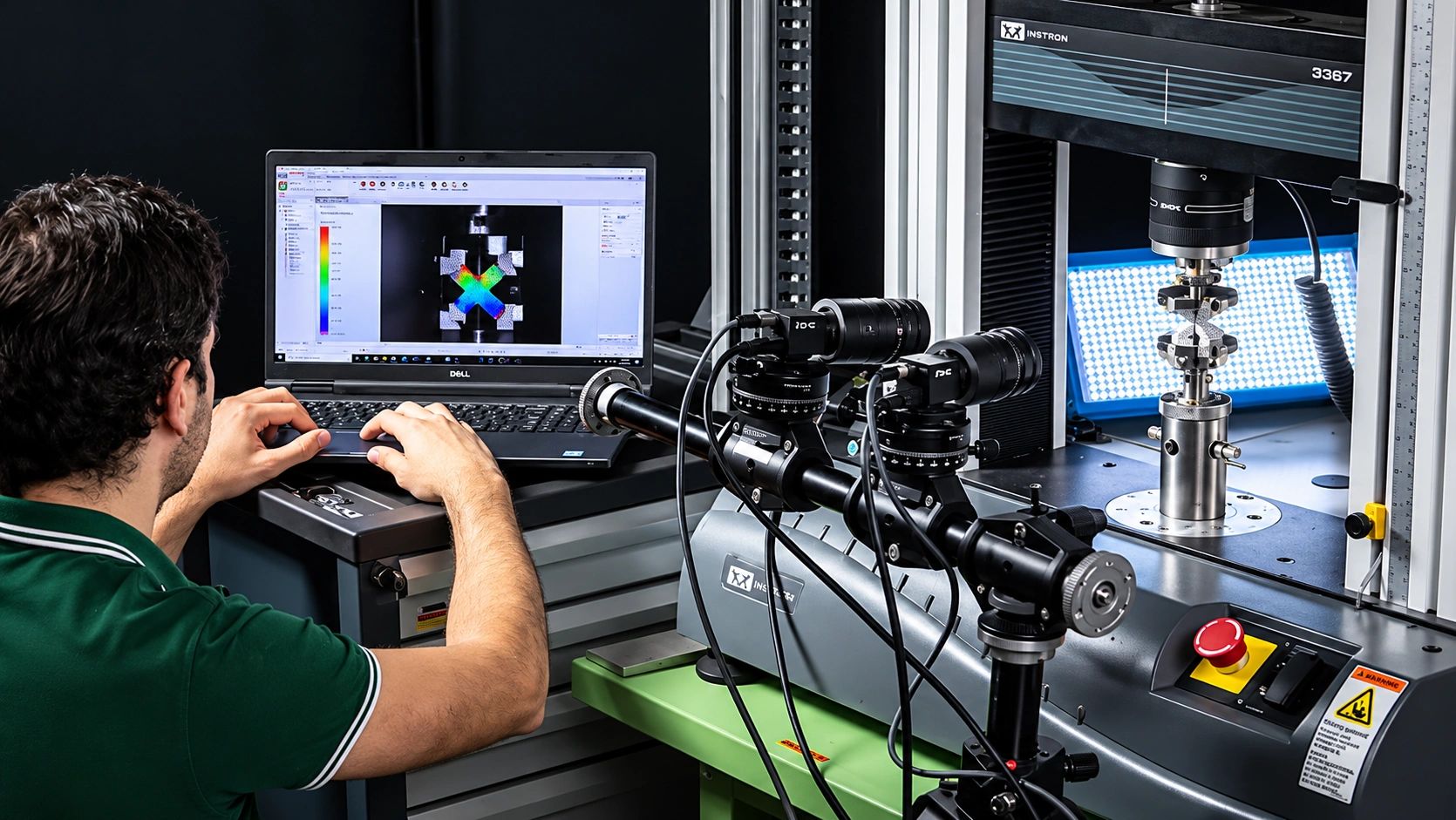
Turnkey Solutions for your Application
MatchID combines powerful DIC software with flexible hardware configurations, allowing measurement systems to be tailored to your application, specimen size, field of view and testing speed.
For quasi-static testing, systems can be configured with cameras ranging from 2 MP to 24 MP, with lenses selected to achieve the required magnification and measurement coverage. For dynamic and high-speed applications, MatchID can be integrated with suitable high-speed cameras to capture rapid deformation, impact events, crack propagation, and transient material behaviour.
Orbidot helps you select and integrate the appropriate cameras, optics, lighting and supporting hardware to build a DIC measurement system suited to your experimental requirements.
2D Package
SOFTWARE
- Quasi-static or High-Speed Frame Grabber
- 2D DIC
HARDWARE
- 1 Camera
- Lens
- Lights
- Optical Rail
- Camera Mounts
- Tripod
Stereo (3D) Package
SOFTWARE
- Quasi-static or High-Speed Frame Grabber
- Stereo DIC
HARDWARE
- 2 or More Cameras
- Calibration Targets
- Lenses & Lights
- Optical Rail
- Camera Mounts
- Tripod
- MatchID Trigger Unit
- NI DAQ
Premium Package
SOFTWARE
- Quasi-static or High-Speed Frame Grabber
- Stereo DIC
HARDWARE
- 2 or More Cameras
- Calibration Targets
- Lenses & Lights
- Optical Rail
- Camera Mounts
- Tripod
- MatchID Trigger Unit
- NI DAQ - Advanced